Tuesday, January 18, 2011

Craggy Craters on Rhea

This image obtained by NASA's Cassini spacecraft of Saturn's moon Rhea shows craters on the icy moon. Cassini's camera was about 200 kilometers (100 miles) away from Rhea's surface. Once again, Cassini done great job.
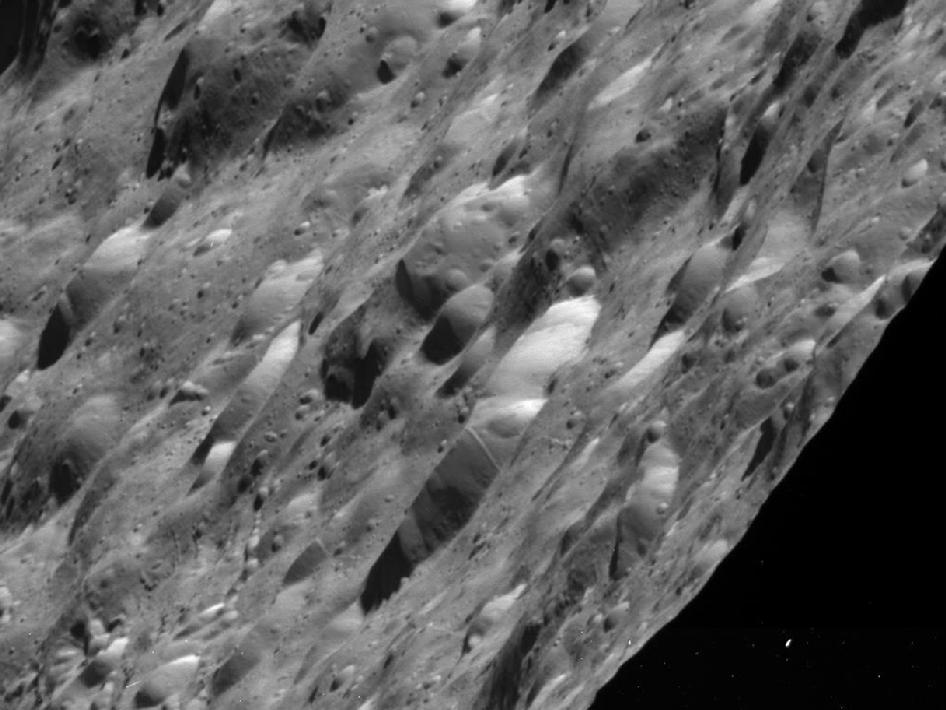
Image credit: NASA/JPL/SSI

Sunday, January 16, 2011

NASA'S Kepler Mission Discovers Its First Rocky Planet

NASA's Kepler spacecraft has discovered Kepler-10b, its first confirmed rocky planet discovered to date. Kepler-10b is 1.4 times the size of Earth and orbits its star in only 0.84 days. Its not habitable zone, liquid water cannot exist.
For more information about the Kepler mission - www.nasa.gov/kepler 
Here is an interesting video with some amazing mathematics in space. Enjoy!


Saturday, January 15, 2011

Tourist Flights to ISS

The Russian Space Agency and the Rocket Space Corporation Energia have agreed to build additional Soyuz spacecraft to carry paying customers to the International Space Station starting in 2013.

"We've got a number of people who have expressed interests over the years who are waiting with bated breath for us to come out with the dates for these new opportunities. So a lot of things are going to start happening as of today" said Eric Anderson, chairman of Space Adventures, told CBS News.

Seat on a Soyuz is believed to run between $30 million and $40 million.

image Credit: NASA/Bill Ingalls

Friday, January 14, 2011

A First Look at Flight in 2025

In late 2010, NASA awarded contracts to three teams - Lockheed Martin, Northrop Grumman, The Boeing Company - to study advanced concept designs for aircraft that could take to the skies in the year 2025.
Each design looks different, but they are all designed for one goal - to protect environment. Less noise, cleaner exhaust and lower fuel consumption - future aircrafts will do that all at the same time. The aircraft will be operated in safely and more modernized air traffic system. Take a look at some images of concepts...

Artist's concept of an aircraft that could enter service in 2025 from the team led by The Boeing Company. Image credit: NASA/The Boeing Company

Artist's concept of an aircraft that could enter service in 2025 from the team led by Lockheed Martin. Image credit: NASA/Lockheed Martin 

Wednesday, January 12, 2011

NASA Research Team Reveals Moon Has Earth-Like Core

State of the art seismological techniques applied to Apollo-era data suggest our moon has a core similar to Earth's.
The team's findings suggest the moon possesses a solid, iron-rich inner core with a radius of nearly 150 miles and a fluid, primarily liquid-iron outer core with a radius of roughly 205 miles. The research indicates the core contains a small percentage of light elements such as sulfur, echoing new seismology research on Earth that suggest the presence of light elements - such as sulfur and oxygen - in a layer around our own core.

(NASA/MSFC/Renee Weber)